
The meditative power of ocean swimming
If you’ve ever stood beside the sea during a storm, it’s easy to see why so many ancient cultures equated an angry ocean to angry gods. Grey clouds seem to stretch all the way down to rough waves, wind whipping at your ankles. And the next morning the same beach might be calm again. As if by magic, it's back to being perfectly still.
As the old saying goes, you can’t step in the same river twice, and the same goes for oceans. To submerge oneself in a body of water, for pleasure or sport, is a form of active meditation. Open-water swimming is remarkably different to doing laps in a controlled environment. Unlike a swimming pool, the ocean can change depth, temperature, colour and texture. Every swim requires patience and presence; an awareness of one’s surroundings.
“I love the feeling of the ocean water against my body,” says Lindy Cook, who regularly swims in Melbourne’s bay. Sometimes it’s silky soft and on other days, when the current is strong, it’s as though it’s more dense and harder to cut through.”
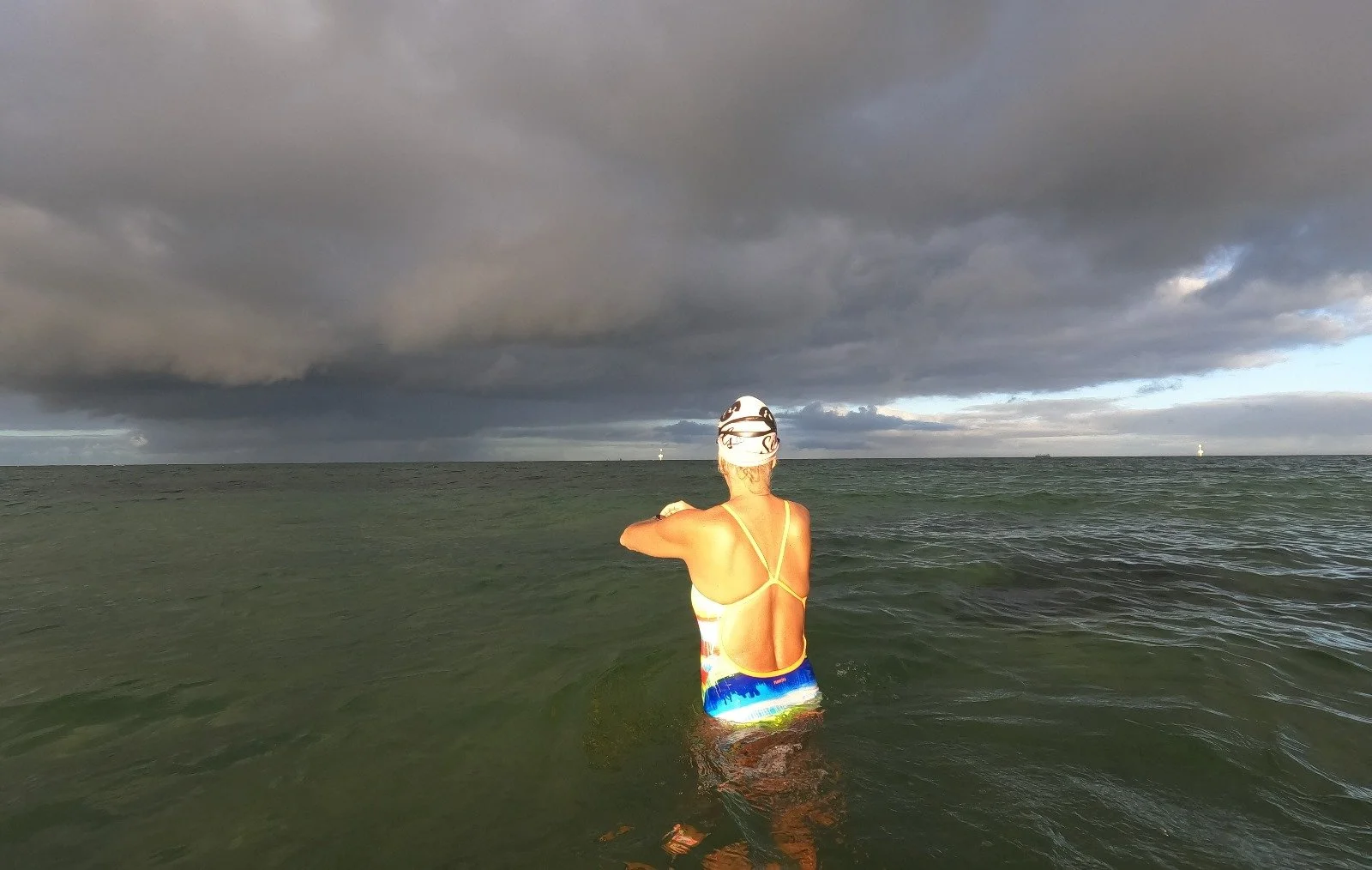
The paradox of the ocean is in that lively tranquility. It’s a friend and a foe, something you need to work with and against. Calm and rough, alive and still. In the early 19th Century science-fiction novel, Twenty Thousand Leagues Under the Sea, French writer Jules Verne wrote: “The sea is an immense desert where man is never alone for he feels life quivering around him on every side.”
For Lindy, water represents freedom, lightness and fluidity of movement. “To me, it's very meditative and I find I can truly be just in that moment,” she says. “Noticing how the water feels on my skin and the rhythm of my stroke. There’s also a liberation in feeling weightless.”
As well as healing wounds, salt water has a buoyant effect, which has held many bodies through gentle periods of strengthening and recovery. In Egypt’s Sharm el Sheikh, artist Sue Austin filmed herself deep-sea diving in a custom wheelchair. In the series titled ‘Creating the Spectacle: Finding Freedom’, Austin moves forward and spins, weightless. As she flips, her hair moves with a soft fluidity that contrasts the rigidity of her wheelchair. These images show the artist floating and sinking, playing with gravity as she inverts stereotypical perceptions of disability.
In these moments, the ocean, with its vastness and unpredictability, can be both a mirror and a balm for the complexities of the human experience. Being submerged is a reminder that we, too, are more than 60% water. In a collection of stories of people’s experiences swimming in Hampstead Heath, Lynn M. Alexander writes: "In the water, I feel part of something much larger than myself, and the pond is a place where the ordinary world falls away. In these moments, time seems to stretch and shrink at once, and I am connected to something timeless."
According to this year’s Trends in Travel report, people are looking for ‘detour destinations’ away from busy tourist spots. The majority of travellers want to embrace the joy of ‘natural phenomenon’; seeking out seas sparkling with bioluminescence, swimming holidays and whale watching.
It’s no wonder that people are valuing escapes that tap into that feeling of awe and wonder; of ancient wisdom and nature that can’t be tamed.
And as we live in an increasingly digital world, where we are tethered to phones, desks and laptops, surrendering to the whims of water has never felt more powerful.
Words by Hannah Bambra